

If you’ve been doing SEO for any length of time, you’ve probably heard “structured data is important” repeated so often it’s lost all meaning. But here’s what changed: in March 2025, both Google and Microsoft publicly confirmed they use schema markup for their generative AI features. ChatGPT followed suit, confirming it uses structured data to determine which products appear in its results. That’s not a minor update. That’s the entire search discovery model shifting underneath our feet, and most SEO teams are still treating schema like a checkbox exercise from 2019.
Schema markup is a standardized vocabulary of code (typically in JSON-LD format) added to web pages that tells search engines and AI systems exactly what your content represents, including its entities, properties, and relationships. In 2026, schema markup drives 20 to 40% higher click-through rates through rich snippets, powers inclusion in Google’s AI Overviews and AI Mode, and directly influences whether your content gets cited by ChatGPT, Perplexity, and other AI search platforms. It has evolved from an optional SEO tactic into the primary communication layer between your content and every major discovery platform.
This guide covers the schema types that still matter after Google’s January 2026 deprecations, walks through implementation step by step, shows you how to validate and test your markup, and, most importantly, explains how structured data now determines visibility across both traditional search and AI-powered discovery. We’re working with real data, named tools, and actual processes. No hand-waving.
Why Schema Markup Became Non-Negotiable in 2026
For years, schema markup was a “nice-to-have.” You could rank perfectly fine without it. Rich snippets were a bonus, a cherry on top of solid on-page SEO.
That era is over.
The shift started accelerating in 2023 when Google launched Search Generative Experience (later renamed AI Overviews). Then AI Overviews expanded globally in late 2024 and early 2025. By March 2025, data from Inner Spark Creative showed AI Overviews appeared on roughly 13.1% of US desktop queries, up from 6.5% just two months earlier. When a featured snippet or AI Overview occupies the top slot, the first organic result’s CTR ranges between 38.9% and 42.9%, according to First Page Sage’s 2025 analysis. Miss that slot, and you’re fighting for scraps.
Here’s what really forced the industry’s hand though. Both Google and Microsoft stated in spring 2025 that structured data is critical for their generative AI features because it’s “efficient, precise, and easy for machines to process.” At Tonic Worldwide, we saw the impact almost immediately across client accounts. Pages with well-structured schema started showing up in AI-generated responses more consistently than those without. Google’s Knowledge Graph, which contains over 500 billion facts about 5 billion entities, feeds directly into Gemini and AI Overviews. Your schema markup is literally how you feed that graph.
And the numbers keep stacking up. Industry data compiled across multiple studies shows rich results capture 58% of clicks on search results versus 41% for non-rich results. Pages that show as rich results saw an 82% higher CTR versus standard listings, according to Google’s own case studies. That isn’t marginal. That’s the difference between a page that generates revenue and one that sits there collecting dust.
What Is Schema Markup and How Does Structured Data Work?
Schema markup is code, written in JSON-LD, Microdata, or RDFa, that you add to your web pages to give search engines explicit context about your content. Think of it as a label maker for the web. Instead of leaving Google to infer that “47.99” on your page is a price and “4.8 out of 5” is a rating, schema tells it directly: this is a Product, its price is $47.99, and its aggregate rating is 4.8 from 312 reviews.
The distinction between the three common terms trips people up, so let’s clear it fast. Schema.org is the vocabulary, the dictionary of terms. Structured data is the actual data itself, formatted according to that vocabulary. Rich snippets (and the broader category of “rich results”) are what shows up in search results when Google reads your structured data and decides to display something enhanced: star ratings, prices, cooking times, FAQ dropdowns, event dates.
JSON-LD is Google’s explicitly recommended format in 2026. It separates schema from your HTML, sitting in a <script> tag in the page’s <head>, which makes it dramatically easier to maintain than Microdata (embedded directly into HTML tags). If you’re starting a fresh implementation today, JSON-LD is the only format worth considering. Period.
The real mental shift for 2026? Schema isn’t just about earning those pretty star ratings anymore. Search Engine Journal quoted Google’s John Mueller on Reddit: structured data types “come and go, but a precious few you should hold on to.” The purpose has broadened. Schema now serves as the machine-readable data layer that AI systems use to understand, verify, and cite your content. That’s a fundamentally different value proposition than chasing rich snippets alone.

What Changed in January 2026? Google's Deprecations Explained
If you follow SEO news, you probably saw the mild panic in November 2025 when John Mueller announced Google would deprecate several structured data types starting January 2026. Some folks interpreted this as Google killing schema entirely. They were wrong, but the changes do matter.
Google phased out support for these lesser-used schema types: Practice Problem (educational problem-solving markup), Dataset (now only serves Dataset Search, not general search), Sitelinks Search Box (being integrated into core search), SpecialAnnouncement (COVID-specific markup no longer needed), and Q&A (limited adoption and overlap with other types). On top of that, Google removed several small SERP features like the “Today’s Doodle” box, nutrition facts panels, nearby offers and events, local bikeshare station status, and the TV season selector.
Mueller clarified on Reddit that these represent “a visual and functional refinement, not an algorithmic penalty.” Sites using deprecated schema won’t see ranking drops. They just won’t receive rich results for those specific types anymore. Search Engine Journal’s coverage was clear: Google is not diminishing structured data. It’s pruning what doesn’t get used.
The core schema types that drive real business value remain fully supported and, frankly, more important than ever: Product, Article, Organization, Person, Review/AggregateRating, LocalBusiness, Event, FAQ (for authoritative government and health sites), Video, Recipe, and Breadcrumb. If you’re using any of those, you’re fine. Better than fine. You’re positioned ahead of the curve as Google concentrates its rich result support on fewer, higher-impact types.
What should you actually do? Audit your site for deprecated markup. Remove or disable anything that only powered disappearing features. Adjust your Search Console dashboards before the data gaps cause false alarms. And then redirect that energy toward the schema types that still deliver measurable results.
How Do Rich Snippets Impact SEO and Click-Through Rates?
Rich snippets don’t just look better in search results. They fundamentally change user behavior. The data on this is overwhelming, and it’s been consistent for years.
According to Searchmetrics data cited by Search Engine Land, 36.6% of searches display at least one rich snippet with information derived from schema markup. First Page Sage’s 2025 data puts the CTR for a featured snippet at 42.9%, the highest of any element on the search results page. That’s higher than the standard #1 organic position. Milestone Research data found that FAQ rich results specifically carried an average CTR of 87%, though keep in mind that Google restricted FAQ rich results to authoritative government and health websites in 2024, so that stat applies to a narrower set of sites now.
For e-commerce, the impact is particularly stark. Search Pilot ran a controlled test and found that adding Review schema alone to product pages increased traffic by 20%. Industry quarterly reviews from early 2025 consistently showed significant CTR improvements when rich results were awarded, with product schema delivering as much as 4.2x higher Google Shopping visibility in documented case studies.
But here’s a nuance most guides skip: rich snippets aren’t guaranteed. Schema markup makes you eligible for rich results. Google’s algorithms make the final call. The timeline from implementation to rich result display typically runs 2 to 12 weeks based on industry analysis. And Google has been clear: altering your structured data frequently can reset the process entirely.
The practical takeaway? Implement schema once, implement it correctly, validate it thoroughly, then leave it alone and monitor through Search Console. Chasing quick wins by constantly tweaking markup is counterproductive.

How to Create Rich Snippets: Step-by-Step Implementation
Getting rich snippets isn’t mysterious, but it does require precision. Here’s the actual process.
Step 1: Identify your content types. Walk through your site and match each page template to the appropriate schema type. Product pages get Product schema. Blog posts get Article or BlogPosting. Your About page gets Organization and Person. Local businesses add LocalBusiness. Event pages get Event schema. Don’t try to mark up everything at once. Start with your highest-traffic templates.
Step 2: Generate your JSON-LD markup. You have three paths. If you’re on WordPress, most major SEO plugins now auto-generate schema for common content types, supporting 20+ schema types including custom schema. The workflow is usually the same: open your post editor, find the schema tab, choose your type, and fill in the fields. The plugin auto-populates many fields from your content, but always review for accuracy. For other CMS platforms, Google’s Structured Data Markup Helper or standalone JSON-LD generators can create clean code. If you’re comfortable with code, write it manually using Schema.org’s documentation as your reference.
Step 3: Add the code to your pages. JSON-LD goes in a <script type=”application/ld+json”> tag, ideally in the <head> of your HTML. Here’s a minimal Article example:
{
"@context": "https://schema.org",
"@type": "Article",
"headline": "Your Article Title",
"author": {
"@type": "Person",
"name": "Author Name"
},
"datePublished": "2026-02-01",
"publisher": {
"@type": "Organization",
"name": "Your Company"
}
}
Step 4: Validate. This is where most implementations fail because people skip validation and wonder why rich results never appear. Use Google’s Rich Results Test (search.google.com/test/rich-results) to check if your page is eligible for specific rich results. It’ll show you errors (must fix) and warnings (should fix). Then run your markup through the Schema.org Validator for full syntax checking across all schema types, including those Google doesn’t use for rich results but that AI systems may still consume.
Step 5: Deploy, submit, and monitor. Push your changes live, use Search Console’s URL Inspection tool to request re-indexing, and submit an updated sitemap. Then monitor the Enhancements reports in Search Console for validation errors and track rich result impressions over the next 2 to 12 weeks.
The most common mistakes that prevent rich results? Missing required properties (every schema type has specific fields Google requires), mismatched content between your schema and visible page content (Google calls this “spam”), and incorrect data types, like putting a string where Google expects a number.
Which Schema Types Deliver the Most Value in 2026?
Not all schema types are created equal. After Google’s January 2026 cleanup, here’s where to focus your energy, ranked by business impact.
Product schema is the single highest-ROI schema type for any e-commerce operation. It displays prices, availability, review ratings, and shipping information directly in search results. Google’s Shopping Graph, which feeds both traditional results and AI Overviews, relies on this markup. If you sell anything online and don’t have Product schema, you’re leaving money on the table.
Review and AggregateRating schema remain powerful across nearly every vertical. Those star ratings in search results aren’t just decorative. Search Pilot’s testing confirmed a 20% traffic increase from Review schema on product pages. The key: your reviews must be genuine, visible on the page, and comply with Google’s review snippet guidelines. Fake or invisible reviews will get you a manual action.
Article and BlogPosting schema are critical for publishers and content-heavy sites. They establish authorship (which feeds E-E-A-T signals), publication dates (freshness signals), and publisher identity. In an AI search context, Article schema helps AI systems attribute your content correctly, which increases your chances of being cited in AI Overviews and ChatGPT responses. AirOps research found that pages with clear authorship structured data earned significantly more AI citations.
Organization and Person schema build your entity presence in Google’s Knowledge Graph. This is the less-visible but strategically important play. When Google understands your organization as an entity with defined relationships, expertise areas, and credentials, it’s more likely to surface your content authoritatively across AI features.
LocalBusiness schema drives local pack visibility for brick-and-mortar businesses. It connects your Google Business Profile to your website entity, reinforcing NAP (name, address, phone) consistency. We’ve seen similar patterns across our client work at Tonic Worldwide. One local business that added LocalBusiness + Product + FAQ schema saw a 40% traffic increase and a 25% increase in walk-ins within a few months.
Event schema generates rich results with dates, locations, and ticket links. If you host or promote events, this is non-negotiable. The visual treatment in search results makes a massive difference for event discovery.
FAQ schema still works but with a major caveat: since 2024, Google only displays FAQ rich results for well-known, authoritative government and health websites. That said, FAQ schema still provides structural value for AI systems. AirOps found that FAQ and Q&A schema appeared in only 10.5% of AI-cited pages, which they identified as an untapped opportunity since the format aligns closely with how AI answer engines retrieve information.

How Does Structured Data Affect AI Search and ChatGPT Citations?
This is the question that separates 2026 SEO strategy from everything that came before.
AI search platforms (Google’s AI Overviews, Google’s AI Mode, ChatGPT Search, Perplexity, Microsoft Copilot) don’t process web content the way traditional crawlers do. They’re building knowledge networks that connect facts, entities, and relationships. Schema markup is the most direct way to feed those networks.
Industry research found that pages with thorough schema markup are 36% more likely to appear in AI-generated summaries and citations. AirOps documented that pages with clean structure paired with schema markup earn 2.8x higher AI citation rates than poorly structured pages. BrightEdge research showed higher citation rates in Google’s AI Overviews on pages with well-implemented schema.
Search Engine Land ran a head-to-head experiment in September 2025 comparing a page with well-structured schema against one without. The page with schema was more likely to appear in AI Overviews.
Fabrice Canel, Microsoft’s Principal Product Manager for Bing, stated at SMX Munich in March 2025 that “Schema Markup helps Microsoft’s LLMs understand content.” That’s about as direct as a platform confirmation gets.
Here’s the practical framework for AI optimization through schema. First, think in terms of entities, not keywords. AI systems want to understand what your content is about at an entity level. Is this a product? A person? An organization? A step-by-step process? Schema defines that explicitly. Second, nest your schema to show relationships. An Article written by a Person who worksFor an Organization: that chain of relationships gives AI systems confidence in attribution. Third, use sameAs properties to link your entities to known references (Wikipedia pages, social profiles, industry databases). This helps AI systems connect your content to their existing knowledge graphs.
The sites winning AI citations right now aren’t just adding basic schema and calling it done. They’re building what the industry refers to as “Content Knowledge Graphs,” interconnected structured data that maps how their content, brand, and offerings relate to one another across their entire site. This is the kind of strategic work we focus on at Tonic Worldwide for our enterprise clients, moving beyond page-level schema into site-wide entity architecture.
What's the Best Schema Markup Validator and Testing Workflow?
Validation is where good intentions meet reality. I’ve seen technically proficient teams deploy schema with typos in required fields and then spend months wondering why rich results never appeared.
Google’s Rich Results Test (search.google.com/test/rich-results) is your first stop. Enter a URL or paste your JSON-LD code directly. It tells you which rich result types your page qualifies for, flags critical errors that block rich results, and shows warnings that reduce eligibility. The test distinguishes between errors (must fix) and warnings (should fix). Focus on errors first, but don’t ignore warnings if you want consistent results.
Schema.org Validator (validator.schema.org) catches syntax issues across the full Schema.org vocabulary, including types Google doesn’t use for rich results but that other platforms (like Bing, Perplexity, or ChatGPT’s web crawlers) may still process. It’s your thorough syntax check.
Google Search Console’s Enhancements reports provide ongoing monitoring after implementation. You’ll see valid items, items with warnings, and errors, plus tracking of impressions and clicks for pages with active rich results. Check this weekly for the first month after deployment, then monthly.
Site-wide auditing tools offer automated schema validation for larger sites. If you’re managing structured data across hundreds or thousands of pages, manual checking isn’t realistic. Enterprise SEO crawlers can scan your entire site, identify missing markup, flag syntax errors, and spot inconsistencies across templates. (If you need help selecting the right auditing stack, our team at Tonic Worldwide can walk you through what fits your setup.)
Here’s a validation workflow that actually works: validate locally (paste code into Rich Results Test before deploying), deploy to a staging environment, validate the live staging URL, push to production, request re-indexing via Search Console’s URL Inspection tool, then monitor Enhancements reports for 4 to 6 weeks. Set a calendar reminder to re-validate after any site redesign, CMS update, or template change. Schema drift after updates is one of the most common causes of lost rich results.
One more thing most guides won’t tell you: the Rich Results Test and Search Console sometimes disagree. A page can pass the test but show errors in Search Console, or vice versa. When this happens, Search Console is the source of truth for how Google actually interprets your live page.
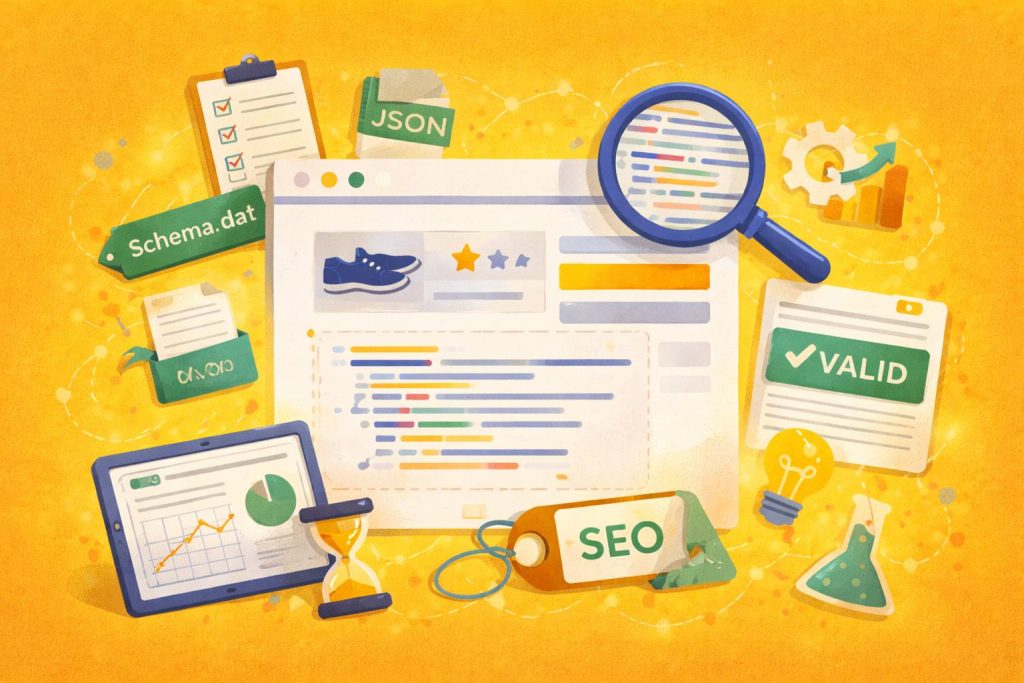
Can You Get Rich Snippets Without Coding? Practical Approaches That Work
You absolutely can, and for most CMS-based sites, the right setup handles 80 to 90% of the job.
If you’re running WordPress, there are several well-established SEO plugins that auto-generate schema markup for common content types. The workflow is largely the same across all of them: open your post or page editor, navigate to the schema settings, select the appropriate type (Article, Product, Recipe, Event, FAQ), and fill in the fields. Most plugins auto-populate common fields like headline, author, date, and featured image from your existing content, but you should always review for accuracy. Some plugins offer a free tier for basics and open up advanced schema generators (custom types, nested entities) in their premium versions.
For non-WordPress platforms like Shopify, Webflow, or custom builds, Google’s Structured Data Markup Helper is a free starting point. It walks you through tagging elements on your page and generates the corresponding JSON-LD. There are also standalone JSON-LD generators that let you fill in fields and copy clean code into your templates.
For enterprise-scale implementations with thousands of pages across multiple content types, you’re looking at dedicated structured data platforms that automate schema generation, build entity relationships across your site, and provide ongoing monitoring and analytics. This is also where partnering with a team that understands schema architecture pays off. At Tonic Worldwide, we’ve found that the gap between “plugin-level schema” and “strategically implemented entity-first schema” is where the biggest ROI differences emerge for our clients.
The honest assessment: off-the-shelf tools get you 80% there with minimal effort. The remaining 20% (nested entity relationships, cross-page entity linking, custom schema for unusual content types) requires either manual JSON-LD work or a strategic partner who can architect it properly. For most small-to-mid-size sites, plugin-level schema is a strong starting point. For brands competing seriously in AI search, that last 20% is what separates you from the pack.

How Should You Structure Schema Markup for Local SEO?
Local businesses have a specific playbook, and it’s one of the highest-ROI schema implementations available.
LocalBusiness schema (or a more specific subtype like Restaurant, Dentist, or AutoRepair) communicates your name, address, phone number, business hours, accepted payments, service area, and geo-coordinates directly to search engines. This data feeds Google’s local pack, those map-based results that appear for “near me” queries and location-specific searches. Getting into the local pack typically means a 3 to 5 position improvement in visibility, based on industry benchmarks we’ve tracked across our own client portfolio.
The critical detail: your schema must match your Google Business Profile exactly. Same business name spelling, same address format, same phone number. Any inconsistency creates entity ambiguity, and ambiguity kills your chances in the local pack.
Here’s the JSON-LD structure you need at minimum:
{
"@context": "https://schema.org",
"@type": "LocalBusiness",
"name": "Your Business Name",
"address": {
"@type": "PostalAddress",
"streetAddress": "123 Main St",
"addressLocality": "Your City",
"addressRegion": "ST",
"postalCode": "12345"
},
"telephone": "+1-555-555-5555",
"openingHoursSpecification": [
{
"@type": "OpeningHoursSpecification",
"dayOfWeek": ["Monday", "Tuesday", "Wednesday", "Thursday", "Friday"],
"opens": "09:00",
"closes": "17:00"
}
],
"geo": {
"@type": "GeoCoordinates",
"latitude": 40.7128,
"longitude": -74.0060
}
}
Layer Review schema on top of LocalBusiness for maximum impact. Those star ratings appearing in local pack results dramatically affect which business gets the click. And add sameAs links to your social profiles, Yelp listing, and industry directories to reinforce entity connections.
Building Schema for AI Visibility: The Entity-First Approach
This is the frontier, where schema stops being a technical SEO task and becomes a strategic content architecture decision.
Traditional schema implementation is page-level: this page is an Article, that page is a Product. The entity-first approach works site-wide. You define your organization as an entity, your key people as entities, your products as entities, and then use schema to map the relationships between them. The result is what we at Tonic Worldwide call a “Content Knowledge Graph,” a machine-readable map of everything your brand represents and how it all connects.
Why does this matter for AI? Because AI systems don’t just pull answers from individual pages. They synthesize information across sources. When your structured data clearly defines that “Jane Smith” (Person) is the “Chief Product Officer” (jobTitle) at “Acme Corp” (Organization) and authored “Guide to Widget Selection” (Article), the AI system can make confident attribution decisions. It knows who wrote what, in what capacity, for which organization. That chain of trust is exactly what Google’s E-E-A-T framework evaluates.
The practical implementation: start with Organization schema on your homepage or About page. Include sameAs links to your Wikipedia page (if you have one), social media profiles, and Crunchbase listing. Then add Person schema for your key authors and subject matter experts, including alumniOf, hasCredential, and award properties where applicable. Industry analysis has shown these credential-level properties materially improve trust signals in YMYL (Your Money, Your Life) contexts. Finally, use author properties on your Article schema that reference these Person entities by @id, creating an explicit link between content and expertise.
This is significantly more work than dropping a plugin onto WordPress and calling it done. But it’s also the approach that’s generating measurable differences in AI citation rates right now. Multiple 2025 best practices analyses found that well-built, entity-focused schema implementations consistently outperformed minimal implementations for AI Overview inclusion.

Community and Engagement: Schema Markup's Role in User Trust
Schema markup doesn’t just talk to algorithms. It shapes user experience before anyone clicks through to your site.
When a search result displays star ratings, review counts, pricing, and availability, it sets expectations. Users who click through have already pre-qualified your content. They know the price. They’ve seen the ratings. This transparency reduces bounce rates because the content matches what they anticipated. The pre-qualification effect leads to better engagement metrics, which search engines interpret as signals of content quality, creating a flywheel that compounds over time.
For e-commerce, this is particularly powerful. A shopper comparing products in search results will gravitate toward listings that show star ratings, price ranges, and stock availability over plain blue links. The information asymmetry gives you an edge before the click even happens.
The community angle extends to review management. Authentic reviews, marked up with Review or AggregateRating schema, serve double duty. They generate rich snippets that boost CTR, and they build social proof that influences purchasing decisions. But the keyword is authentic. Google’s structured data spam policies are explicit: reviews must be genuine, from real users, and visible on the page. Marking up reviews that don’t exist on the page or fabricating ratings will trigger a manual action that strips all your rich results, not just the fake ones.
For content sites, engagement metrics fed by rich snippets create a positive loop. Higher CTR from rich results leads to more traffic. More traffic leads to more user signals. Better user signals reinforce rankings. The virtuous cycle starts with the structured data that earned the rich snippet in the first place.
Trust, Ethics, and Avoiding Structured Data Penalties
Google’s structured data policies aren’t suggestions. They’re enforced guidelines, and violations carry real consequences.
The cardinal rules: your schema must accurately describe content visible on the page. You can’t mark up prices that aren’t displayed, reviews that don’t exist, or events that aren’t happening. Schema that misleads users or search engines violates Google’s spam policies and can result in manual actions that remove all rich results from your site. In severe cases, it can reduce your visibility across all of Google Search.
Specific traps to avoid: don’t mark up content behind tabs, accordions, or login walls unless the content is accessible to Googlebot. Don’t use self-serving reviews (reviewing your own product on your own site for the purpose of generating rich snippet stars). Don’t apply schema types that don’t match your actual content. Marking a blog post as a Product because you want price rich results will backfire.
Google’s documentation, last updated December 2025, is explicit about FAQ schema: it’s now reserved for well-known, authoritative government and health websites only. Adding FAQ schema to a commercial blog won’t generate errors, but it won’t generate rich results either. Don’t waste the effort.
From an ethical standpoint, structured data is a trust mechanism. You’re making explicit claims about your content: who wrote it, when, what it contains, how it’s rated. Treat those claims the same way you’d treat claims on a financial document. Accuracy isn’t just a compliance requirement; it’s how you build the entity trust that powers long-term visibility in both traditional and AI search.
Monitor regularly. Google Search Console’s Enhancements reports will flag issues as they arise. Set a quarterly audit cadence: re-validate your schema, check for drift after site updates, and compare your markup against Google’s current structured data documentation. The documentation is a living resource, and what was valid six months ago may have changed.

What's Coming Next: Schema, Agentic AI, and the Semantic Web
We’re standing at an inflection point that goes well beyond rich snippets.
Microsoft’s announcement of NLWeb, an open initiative led by Schema.org creator RV Guha, signals where structured data is heading. Built on Schema.org vocabulary, NLWeb enables conversational AI interfaces that let users and AI agents query website content in natural language. Early adopters are already using NLWeb for on-site search. The implication is significant: structured data isn’t just about how search engines display your content anymore. It’s about how AI agents interact with it.
Google’s AI Mode, which expanded to over 40 countries in October 2025, uses a fundamentally different approach than traditional search. Instead of ranking pages, it extracts specific chunks of information from sources, synthesizes them, and presents conversational answers with citations. Every chunk needs to be independently understandable and accurately attributed. Structured data provides the attribution framework.
OpenAI’s Deep Research and Perplexity’s Deep Research features both perform intensive retrieval and citation, pulling from pages that offer clear, machine-readable signals. The sites that win these citations consistently have well-implemented schema, clear entity definitions, and content structured for modular extraction.
The trajectory is clear: structured data is becoming the foundational layer of an agentic web, one where AI systems don’t just find information but take actions on behalf of users. Organizations that invest in thorough, semantically rich schema markup now are building the infrastructure that will serve them as search continues evolving into something barely recognizable compared to what it was five years ago. The sites that ignore this transition won’t get penalized. They’ll just gradually become invisible to the systems that increasingly control how people discover information.
Start with the basics: get your Product, Article, Organization, and Review schema implemented correctly. Validate it. Monitor it. Then work your way toward the entity-first approach. Every layer of structured data you add makes your content more legible to every platform that matters, today and in whatever comes next.
If you’re unsure where your structured data stands, or you want to move from basic plugin-level schema to the kind of entity architecture that earns AI citations, the team at Tonic Worldwide can audit your current implementation and map out a strategy that actually moves the needle. Because in 2026, schema markup isn’t a technical detail. It’s a competitive advantage.